Description
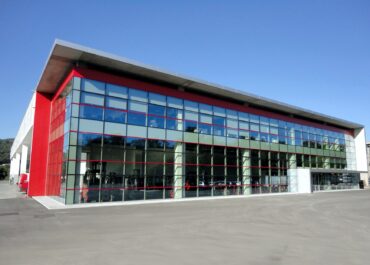
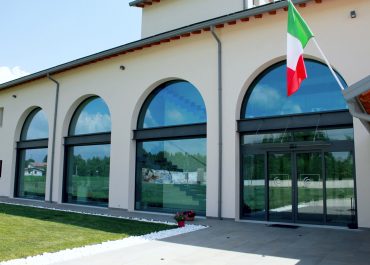
The new headquarters of Destro Paolo — a benchmark of Italian craftsmanship in the world of fashion accessories — are characterized by clean lines and a total whitelook.
Designed by architect Marco Casagrande, this complex and visually distinctive project was the result of close collaboration, with our team involved in the design, fabrication, and installation of the building envelope and other architectural elements.
The cladding provides visual consistency in both colour and style, extending seamlessly to the side elevations. Its tubular profiles, composed of three different sections, appear randomly arranged, creating a light and dynamic pattern that emphasizes the horizontal lines of the façade. These same profiles also function as sunshades, covering the vertical windows and the mullion-and-transom curtain walls behind them. These curtain walls are concentrated in the entrance area, which is covered by a striking cantilevered canopy.
Designed as a micro-architecture, the canopy features a steel structure supported by tie rods. The aluminium tubular infill incorporates irregular oval-shaped openings, disrupting symmetry and adding visual interest. Its integration with the building’s main cladding is achieved through the continuity of colour and the geometric linearity of the aluminium elements.
The project also includes another cantilever roof, this one linear and extending over 200 meters. The roof is clad of aluminium composite panels supported by aluminium profiles, while the structural frame features steel beams and paired columns, creating a rhythmic architectural cadence.
One of the project’s most remarkable features is the large skylight that illuminates the entrance hall’s waiting area.
Measuring 8 x 11 meters and rising 2.4 meters in height, the skylight comprises eleven bays made from Schüco façade profiles. Each bay is filled with triple-glazed panels and equipped with two motorized opening windows.
As for the exterior architectural components, full integration of the metal carpentry fire escape and the technical compartment is ensure by the cladding, which uses the same tubular sections as the main façade. The entrance niche, by contrast, is clad in composite material.
The works are completed by motorised folding doorways and EI 120 fireproof doors.
Inside, the offices of the production area are enclosed by glass walls. Made using cold profiles, they feature glass panels and a covering specifically conceived for acoustic performance.
Finally, a 180 m² carpentry mezzanine – accessible via a staircase with varnished wood treads – is connected to the sixteen-meter-high structural framework of the skylight.
Details
- Customer: Destro Paolo spa
- Location: Vigonza (Padua)
- Year: 2025
- Photos: Nicolli, Areaseb
-
Interventions:
- Mullion-transom façade system Schüco FW 50.
- Aluminium windows system Schüco AWS 75.SI.
- Cladding in fixed sun louvers made of horizontal aluminium tubes with variable section (3 types).
- Aluminium truss skylight realized with Schüco FWS 60 façade system (12x8 m).
- Linear shelter cladded in honeycomb aluminum panel on twin columns and steel beams (primary structure) and aluminum substructure. On three sides of the building (approximately 200x3 m).
- Entrance shelter with load-bearing structure in carpentry and infill in aluminum tubes with irregular oval holes. 16.00x3 m (approximately).
- Entrance niche cladding in composite material.
- Fire escape staircase cladded with the same sunshade tubes.
- Glass partition walls (for offices).
- Carpentry mezzanine complete with access ladder.
- Motorized folding doors.
- EI 120 fire doors.